:+86 15106109009
:sales@couplingzy.com


 English
 русский
 Español
 عربى
 Português
 Deutsch
 Türk
 Indonesia


Disk Coupling Guide: Diaphragm Coupling Types, Selection & Installation
Content
- 1 Diaphragm Coupling vs Disc Coupling: Two Names for One Family
- 2 How the Metal Element Carries Torque and Misalignment
- 3 Head-to-Head Comparison
- 4 Where the Difference Actually Shows Up in Service
- 5 When a Different Coupling Serves You Better
- 6 How We Build and Check These Couplings
- 7 A Practical Selection Checklist
- 8 The Takeaway
Ask three engineers to explain the difference between a diaphragm coupling and a disc coupling and you may get three different answers. Some treat the two names as exact synonyms. Others insist that a diaphragm coupling uses one contoured metal plate, while a disc coupling uses a stack of thin laminated plates. Both views contain some truth, and the practical consequences are usually smaller than the marketing language around them suggests.
The short version: both designs belong to the same family of torsionally rigid, backlash-free metal element couplings. Both transmit torque through thin flexible metal that also absorbs shaft misalignment. The real question is not "diaphragm or disc" but which construction detail fits your torque, speed, misalignment and maintenance reality.
Diaphragm Coupling vs Disc Coupling: Two Names for One Family
A diaphragm coupling typically uses one or two contoured metal diaphragms, formed from stainless or high-strength alloy steel and connected to the hubs by welding, bolting or a clamped joint. The profile of the diaphragm is engineered so that the thin material flexes elastically while still carrying substantial torque from the hub rim to the spacer or the opposite hub.
A disc coupling uses a pack of very thin discs, often between 0.2 mm and 1 mm thick each, stacked and bolted or riveted in an alternating pattern so that torque is shared across many layers. Adding discs raises torque capacity without making the element unacceptably stiff, which is why large disc packs are common on high-power, high-speed trains.
Terminology varies by region and by catalog. What North American suppliers usually call a disc coupling is often sold in Europe and Asia as a diaphragm coupling. When you compare quotations, compare drawings, disc counts, element thickness, bolt patterns and rated misalignment, not the product name.
How the Metal Element Carries Torque and Misalignment
In both designs, torque travels through the flexible metal element, which works mainly in tension and bending rather than in shear. This is why the couplings are torsionally rigid: there is no rubber, no sliding spline and no clearance between teeth, so angular position at the input is reproduced at the output with essentially zero backlash. That quality matters in positioning drives, printing and paper machinery, and any train where lost motion creates quality problems.
Misalignment is handled by elastic flexing of the same element. A single disc pack or diaphragm normally accepts between roughly 0.5 and 1.5 degrees of angular misalignment. Parallel offset is not absorbed by the element itself; it requires a spacer or an intermediate shaft between two packs. Axial displacement, thermal growth and small assembly tolerances are accommodated within limits that depend on element thickness and stack height.
Axial Stiffness Is the Quiet Deciding Factor
Because both couplings are stiff in the axial direction, they push back against the shafts when stretched or compressed. On cold equipment this rarely matters. On hot equipment, or where a long shaft grows several millimetres between cold and hot conditions, that restoring force loads the bearings continuously. A disc pack with more, thinner layers is usually a little more forgiving axially than a single thick diaphragm, which is one reason laminated packs dominate in high-temperature turbomachinery.
Head-to-Head Comparison
The table below summarizes how the two constructions usually behave. Treat it as general guidance, because real limits depend on size, disc count, bolt design and the manufacturer's own testing.
| Characteristic | Diaphragm Coupling | Disc Coupling |
|---|---|---|
| Flexible element | One or two contoured metal diaphragms | Laminated stack of thin discs |
| Torque capacity | High, set by diaphragm profile and thickness | High, increased by adding disc layers |
| Angular misalignment | About 0.5 to 1.5 degrees per element | About 0.5 to 1 degree per pack |
| Parallel offset | Needs spacer or intermediate shaft | Needs spacer or intermediate shaft |
| Axial stiffness | Very stiff | Stiff, slightly softer with more layers |
| Backlash | None | None |
| Lubrication | Not required | Not required |
| High-speed balance | Excellent | Excellent with balanced packs |
| Inspection and repair | Element usually replaced as a unit | Bolted packs can be re-plated or replaced |
| Relative cost | Often lower at equal torque | Slightly higher for large bolted packs |
| Typical duty | Pumps, compressors, blowers, metallurgical drives | Turbomachinery, spindles, precision drives |
Where the Difference Actually Shows Up in Service
In day-to-day plant conditions, three factors separate the two designs. The first is the bolted joint. Bolted disc packs can be opened, inspected and rebuilt, which suits plants that must document condition at every major overhaul. A welded diaphragm is usually replaced as a complete element, which is simpler but less flexible if you want to extend service life by re-plating.
The second is fatigue under cyclic torque. Reversing drives, reciprocating compressors and rolling mill auxiliaries load the element millions of times. Thin laminated discs distribute that load across many layers, while a single diaphragm concentrates stress in its profile. Both survive well when correctly sized; both fail early when they are not.
The third is environment. Stainless elements resist most industrial atmospheres, but chlorides, acid vapour and salt spray still attack them. In those conditions disc thickness matters, because a thin disc loses section faster than a thicker diaphragm.
Long Spans and Spacers
Whenever the two machines sit far apart, or the coupling must be removed without moving either machine, you are really specifying a spacer coupling. Two element packs, one stiff tube, and a defined length become the deciding parameters. This is the configuration we build most often for pump sets, test stands and mill drives where maintenance access is tight.
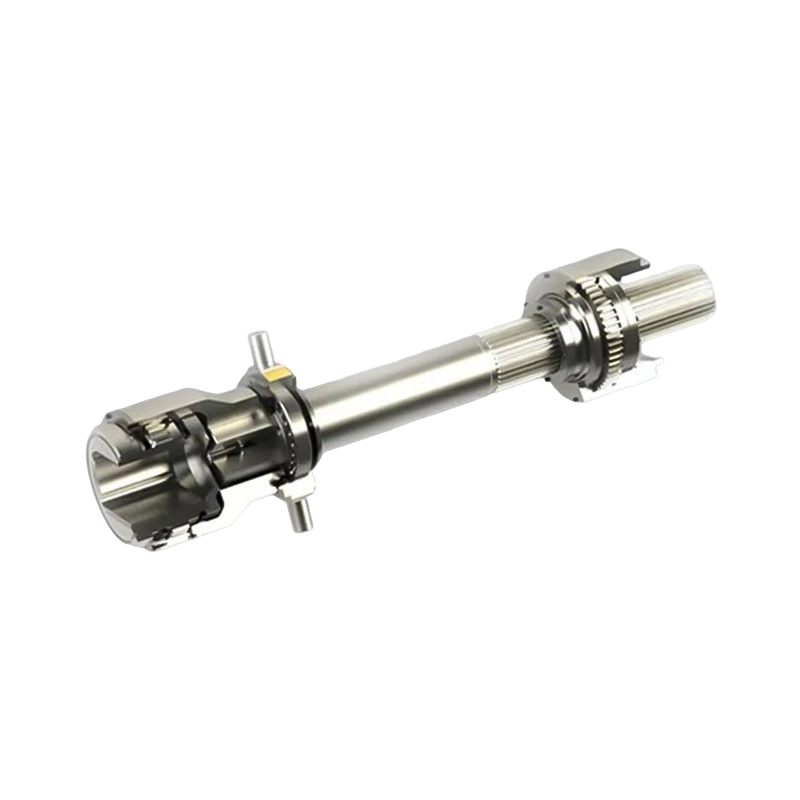
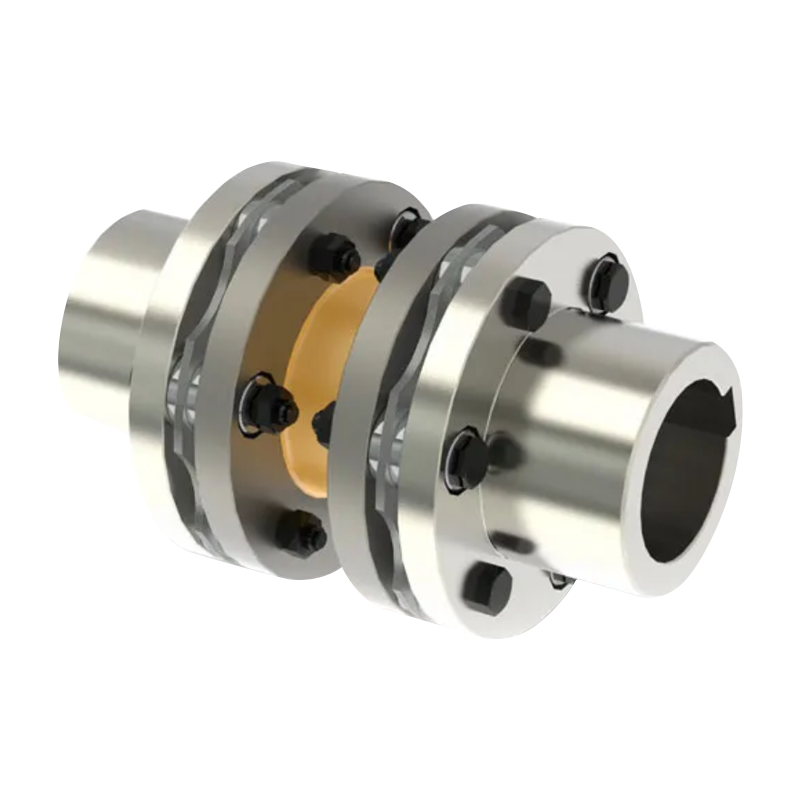 MPJ Spacer Diaphragm Coupling with Intermediate ShaftFor long-span power transmission, this spacer-type metal diaphragm coupling compensates misalignment while providing high torsional rigidity and lubrication-free operation.View Product →
If you are installing one of these units, the alignment procedure deserves as much attention as the selection itself. We have set out a step-by-step walkthrough of the installation steps of the diaphragm coupling that covers centre finding, bolt tightening sequence and the checks worth repeating after the first hot run.
When a Different Coupling Serves You Better
Metal element couplings are not the answer to every drive problem. If you need very high torque at low speed, can tolerate a little backlash, and have someone available to grease the coupling, a drum gear coupling is often the more economical and more forgiving choice. Its crowned tooth profile handles both angular and radial displacement in one compact package, and it tolerates the rough alignment that comes with heavy handling equipment.
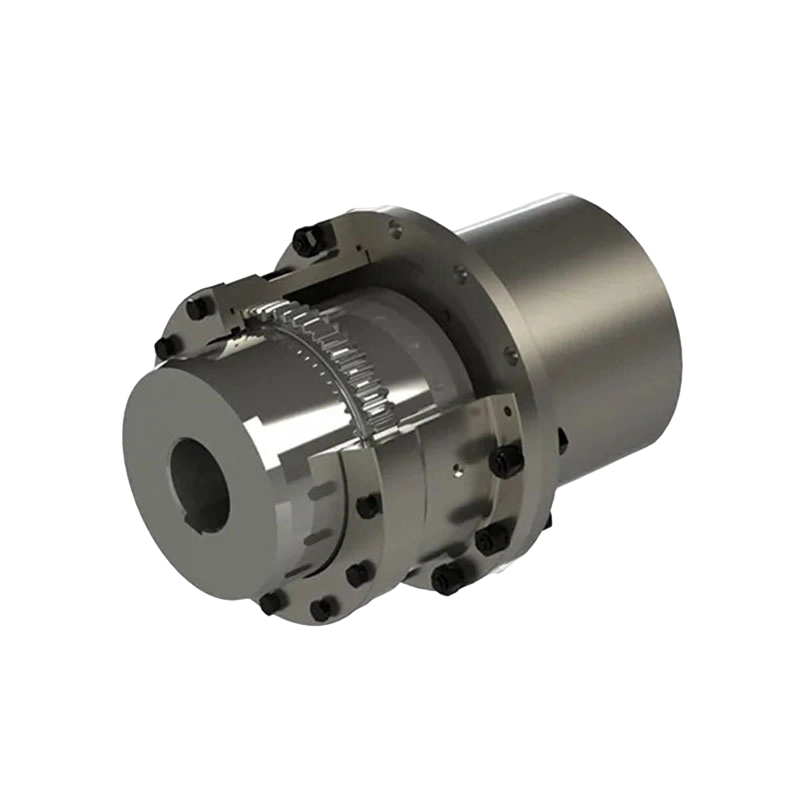
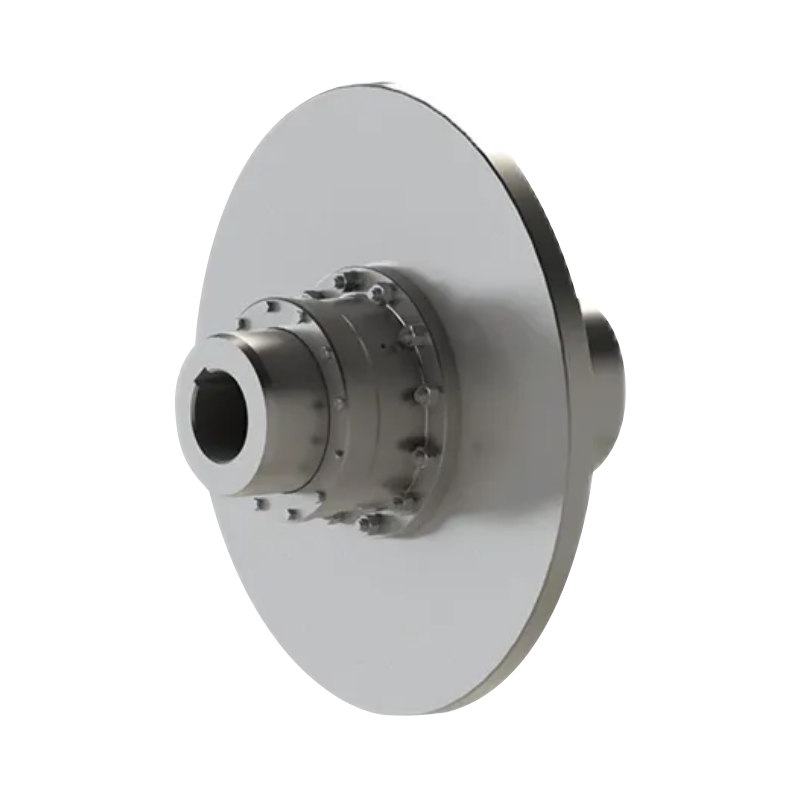 GA Series Heavy-Duty Drum Gear CouplingFor high-torque, low-speed drives, this robust drum gear coupling compensates angular and radial misalignment and suits heavy handling, mill, and marine applications.View Product →
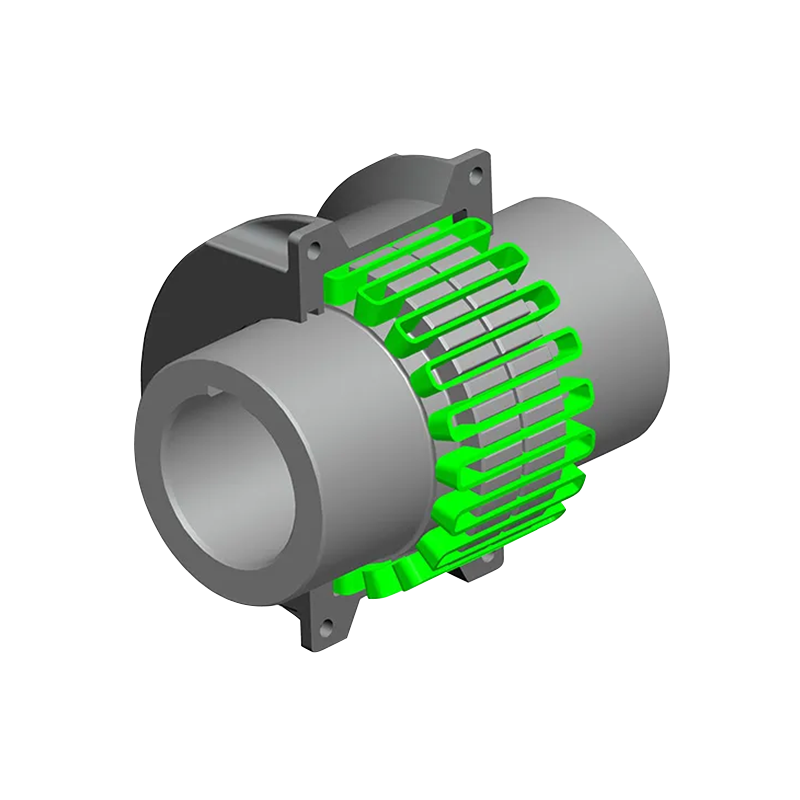
Snake spring couplings suit shock-loaded drives where some torsional resilience is welcome. Elastomer couplings such as tyre, star and sleeve-pin types damp vibration and are inexpensive to re-bush, but their rubber elements age, soften at temperature and add a small amount of wind-up that positioning systems dislike. Safety couplings belong in a different conversation altogether, since their job is to release or slip when torque exceeds a set value.
How We Build and Check These Couplings
Zhongye Heavy Industry Technology has been manufacturing couplings in Zhenjiang, Jiangsu since 2014, and metal element couplings are one of our core product lines. The range covers single and double diaphragm designs, spacer types with intermediate shafts, and higher-torque variants for heavy duty. Alongside the standard catalogue we design and manufacture non-standard couplings, which is often the fastest route when a machine has an unusual shaft diameter, an odd span or a space envelope that no catalogue size fits.
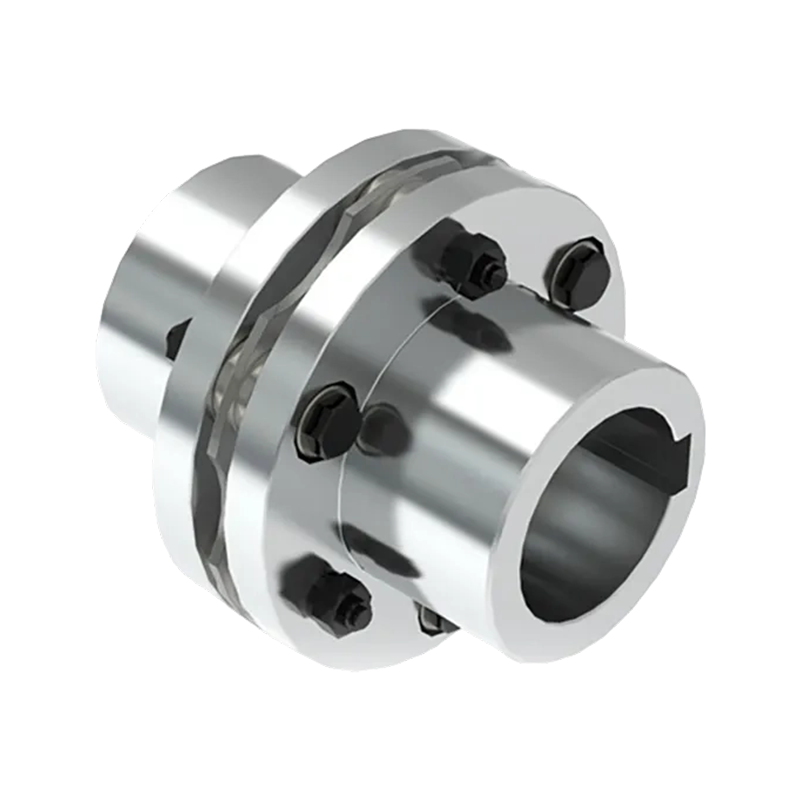
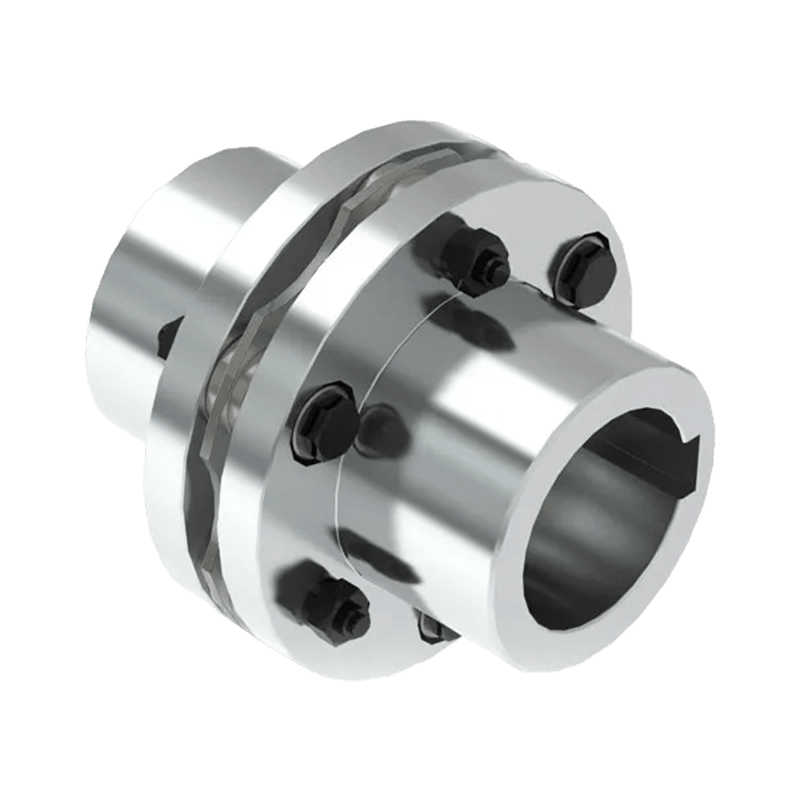 DMA Single Type Elastic Diaphragm CouplingA keyed, single-diaphragm metal coupling for precision torque transfer, offering zero backlash, high torsional rigidity, and lubrication-free operation.View Product →
Our workshops include a 5,500 square metre heavy machining hall and a 4,600 square metre precision hall, so both large flanges and fine disc stacks can be produced in house. Incoming material, heat treatment and final dimensions are checked before dispatch, and we are happy to discuss the tolerances that matter most for your particular train. A fuller description of our manufacturing and testing capability is available on our company capability page.
A Practical Selection Checklist
Before you decide between a diaphragm and a disc coupling, gather the following information. It will shorten the conversation with any supplier considerably.
- Rated and peak torque of the drive, including starting torque and any stall condition.
- Continuous and maximum speed, plus whether the train passes through a torsional critical speed.
- Angular, parallel and axial misalignment expected after alignment, not the ideal figure.
- Distance between shaft ends and how much space is available for removal and refitting.
- Ambient and operating temperature, humidity, dust and any corrosive vapour.
- Shaft diameters and keyway or clamping details on both sides.
- Bearing arrangement and whether the bearings can accept the coupling's axial restoring force.
- Maintenance policy: replace as a unit, or open, inspect and rebuild on site.
The Takeaway
Diaphragm coupling versus disc coupling is often a comparison between two branches of the same family rather than two rival technologies. The laminated disc pack and the contoured diaphragm behave in similar ways: torsionally stiff, backlash-free, lubrication-free and capable of long service when sized correctly. Choose on element thickness, disc count, axial stiffness, bolted or welded joints, and the maintenance practice your plant actually follows.
Send us the duty data and a simple sketch of the shaft arrangement, and we will tell you honestly which construction fits, and where a drum gear or elastomer coupling would serve you better.
- Quick Links
- About
- Products
- Our Service
- News & Events
- Contact
- Products Series
- Flexible Couplings with Non-Elastic Elements
- Flexible Couplings with Metal Elastic Elements
- Flexible Couplings with Non-Metallic Elastic Elements
- Safety Coupling
- Rigid Coupling
- Contact Us
- Tel : +86 511 8572 3800 +86 511 8572 3900
- Mobile : +86 15106109009
- Email : sales@couplingzy.com
- Add:No.1 Zhongye Yingbin Avenue, Gaozi Street, Dantu Economic Development Zone, Zhenjiang City, Jiangsu Province, China.


