

 English
  русский
  Español
  عربى
عربى  Português
  Deutsch
  Türk
Türk  Indonesia
The global transition toward renewable and new energy systems has placed extraordinary demands on mechanical components that were once considered secondary to overall system design. Among these, couplings for new energy equipment have emerged as critical elements that directly influence drivetrain efficiency, system longevity, and operational reliability. Wind turbines, solar tracking drives, hydrogen fuel cell compressors, electric vehicle powertrains, and grid-scale energy storage systems all rely on precision couplings to transmit torque cleanly, absorb dynamic loads, and accommodate the inevitable misalignments that arise in real-world installation and operation.
Within this broader category, flexible couplings with metal elastic elements have gained significant traction as the preferred solution for the most demanding new energy applications. Their ability to combine high torque transmission capacity with measurable flexibility — without sacrificing the dimensional precision or temperature resistance that polymer-based alternatives struggle to maintain — makes them uniquely suited to the rigorous operating environments that define modern energy infrastructure.
Understanding Flexible Couplings with Metal Elastic Elements
A flexible coupling is a mechanical device that connects two shafts — typically a driving shaft and a driven shaft — while accommodating angular, radial, and axial misalignments between them. Unlike rigid couplings, which demand near-perfect shaft alignment and transmit vibration directly between connected components, flexible couplings introduce a controlled degree of compliance into the drivetrain. This compliance serves multiple functions: it reduces peak shock loads, dampens torsional vibrations, compensates for thermal expansion, and extends the service life of connected bearings and seals.
In couplings with metal elastic elements specifically, this flexibility is achieved not through rubber, polyurethane, or other polymer intermediaries, but through precisely engineered metallic components — most commonly thin steel discs, diaphragms, leaf springs, or serpentine spring packs. These elements deform elastically under load, storing and releasing energy in a controlled, repeatable manner without permanent deformation. The result is a coupling that is simultaneously flexible and highly durable, capable of operating across wide temperature ranges and in environments where polymer degradation would render softer alternatives unreliable.
Principal Types of Metal Elastic Elements
The design space for metal elastic elements is broad, and different geometries produce meaningfully different performance characteristics. The most widely used types in new energy equipment include:
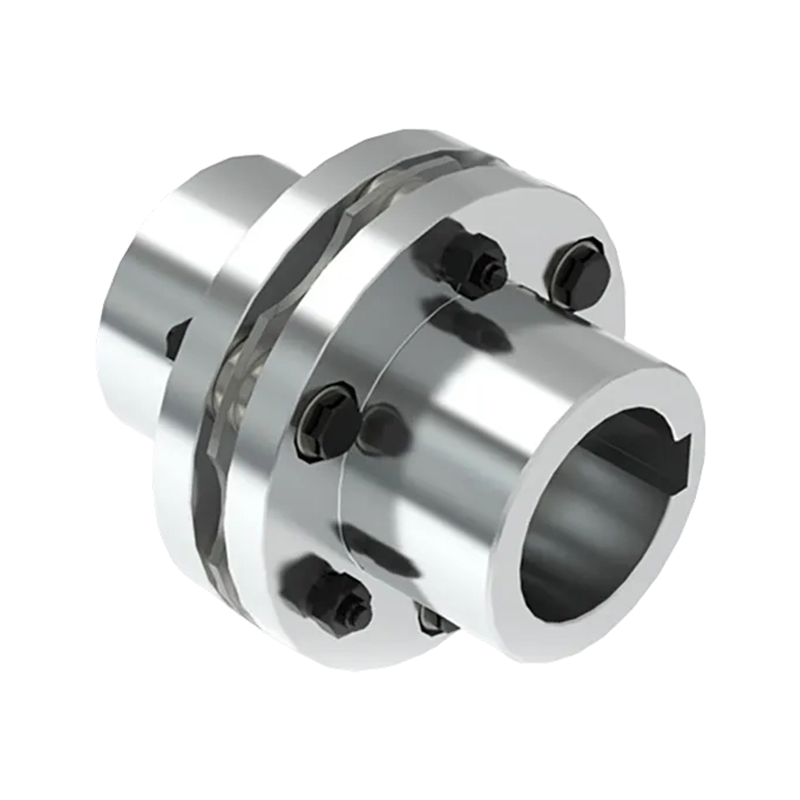
- Disc pack couplings: These use a series of thin, precision-stamped steel discs bolted alternately to flanges on the driving and driven sides. Under torque, the discs flex in bending, accommodating angular and axial misalignment while transmitting high torque with minimal backlash. Disc pack couplings are a dominant choice in wind turbine generator connections and high-speed electric motor test rigs.
- Diaphragm couplings: Featuring one or more contoured metal diaphragms welded or bolted between hubs, diaphragm couplings excel in high-speed applications where balance and torsional stiffness are paramount. Their single-piece diaphragm design eliminates fastener fatigue points and makes them preferred in turbomachinery, including compressors used in hydrogen production and liquefied natural gas processing.
- Bellows couplings: The corrugated metal bellows element offers high axial compliance and excellent angular flexibility in a compact envelope. Bellows couplings are frequently used in servo-driven solar tracking systems and precision positioning stages where zero backlash and high torsional stiffness must coexist.
- Serpentine spring couplings: A sinusoidal steel spring element interlocks with mating teeth on two hubs, providing torque transmission with controlled torsional flexibility and excellent shock absorption. These are commonly found in industrial generator sets and energy storage flywheel systems.
- Leaf spring couplings (Oldham-type with metal elements): Thin metal leaves arranged radially accommodate radial misalignment while maintaining torsional rigidity, suited to applications with significant parallel shaft offset.
Why Metal Elastic Elements Outperform Polymer Alternatives in New Energy Contexts
Polymer flexible couplings — using rubber spiders, polyurethane jaw inserts, or elastomeric tire elements — have served industry reliably for decades and remain appropriate in many standard applications. However, the specific operating conditions of new energy equipment expose the limitations of polymer elements in ways that are difficult to engineer around.
Temperature Resistance
New energy systems frequently operate at thermal extremes. Offshore wind turbines must function in sub-zero Arctic conditions. Concentrating solar power (CSP) plants expose drivetrain components to sustained high ambient temperatures. Hydrogen fuel cell balance-of-plant compressors cycle through wide thermal ranges with each start-stop event. Polymer coupling elements are inherently temperature-sensitive: elastomers stiffen and lose flexibility in cold conditions, increasing shock transmission, while elevated temperatures accelerate creep, hardening, and eventual cracking. Metal elastic elements, by contrast, maintain their mechanical properties across a temperature range typically spanning −60°C to +300°C or beyond, depending on alloy selection, making them inherently more reliable across the full operational envelope of new energy systems.
Aging and Service Life
Polymer materials age through mechanisms including oxidation, UV degradation, ozone attack, and fatigue cracking — all of which are accelerated in the outdoor or chemically active environments common in energy infrastructure. A rubber coupling element installed in a rooftop solar tracking drive may begin to degrade within three to five years under sustained UV and ozone exposure, introducing vibration and eventual failure into a system designed for a 25-year service life. Metal elastic elements, absent corrosion (which is managed through material selection and surface treatment), do not age in any meaningful sense over typical equipment design lives. Their fatigue behavior is predictable and amenable to engineering calculation, enabling confident lifetime predictions that polymer elements cannot support with the same rigor.
Torsional Stiffness Consistency
The torsional stiffness of a coupling — its resistance to angular deflection per unit of applied torque — directly influences the resonant frequencies of the connected drivetrain. System designers must know this stiffness value accurately and must be able to rely on it remaining stable throughout the equipment's life. Polymer coupling stiffness varies with temperature, load history, and age, shifting resonant frequencies in ways that can introduce unexpected vibration problems. Metal elastic elements provide a consistent, well-defined torsional stiffness that does not vary with environmental conditions or service history, enabling accurate rotordynamic analysis and confident resonance avoidance in the design phase.
Lubrication-Free Operation
Many metal coupling designs — particularly disc pack, diaphragm, and bellows types — are entirely lubrication-free. This characteristic is particularly valuable in new energy applications where maintenance access is difficult or costly: offshore wind turbine nacelles, remote desert solar installations, or subsea tidal energy generators. Eliminating lubrication requirements removes a maintenance task, a contamination risk, and a potential failure mode simultaneously.
Key Applications in New Energy Equipment
Wind Energy: Turbine Drivetrains
The wind turbine drivetrain represents one of the most demanding coupling applications in any industry. The main shaft connecting rotor hub to gearbox — or directly to a permanent magnet generator in direct-drive configurations — must transmit fluctuating torques driven by variable wind loads, absorb bending moments from rotor thrust, and accommodate shaft deflections induced by these loads. Disc pack couplings are widely specified for this interface, particularly in the main shaft-to-gearbox connection in multi-stage drivetrains, where their high torque capacity, misalignment accommodation, and proven fatigue life in pulsating load conditions are decisive advantages. In the high-speed generator coupling at the gearbox output, diaphragm couplings are frequently preferred for their superior balance characteristics and suitability for shaft speeds that can exceed 1,500 RPM in larger turbines.
Solar Energy: Tracking System Drives
Single-axis and dual-axis solar tracking systems use electric motor drives to orient photovoltaic panels or parabolic trough collectors toward the sun throughout the day. The coupling between motor output shaft and tracker drive input must handle low to moderate torque, operate maintenance-free for 25 years or more, and accommodate the small but persistent misalignments that arise from thermal expansion of the tracker structure. Bellows couplings and precision disc couplings are well suited to this role, providing zero backlash (essential for accurate positioning), high torsional stiffness (for responsive positioning), and entirely lubrication-free operation across the full climatic range of solar installation sites worldwide.
Hydrogen Production: Compressor and Pump Drives
Green hydrogen production via electrolysis requires high-pressure compressors to bring hydrogen to storage or pipeline pressures, and these compressors are driven by electric motors through precision couplings. The operating environment is chemically sensitive — hydrogen embrittlement is a known concern for some steel grades — and reliability is paramount in facilities where unplanned downtime carries significant economic and safety consequences. Diaphragm couplings manufactured from hydrogen-resistant alloys (typically austenitic stainless steels or specialized nickel alloys) are the standard specification for these applications, valued for their zero-leakage design, lubrication-free operation, and ability to accommodate the thermal growth between motor and compressor casings during operation.
Battery Energy Storage Systems (BESS) and Flywheel Storage
Grid-scale energy storage increasingly relies on flywheel systems for short-duration, high-cycle applications, and on motor-generator sets for longer-duration storage. Flywheel systems in particular demand couplings with exceptional balance, minimal windage losses, and the ability to withstand millions of load cycles without fatigue failure. Diaphragm and bellows couplings, dynamically balanced to fine tolerances and selected for high-cycle fatigue resistance, are the standard approach. Serpentine spring couplings find application in larger generator set installations where shock load absorption is a primary concern during grid fault events.
Electric Vehicle Powertrain Testing
While not a field installation, EV powertrain development relies heavily on test bench coupling technology, and the demands are severe: high rotational speeds, rapid torque reversals, and the need for precise torque measurement between drive motor and dynamometer. Disc pack and diaphragm couplings, often integrated with torque measurement flanges, are the standard for this application, providing the torsional stiffness needed for accurate dynamic measurement while accommodating the misalignments inherent in test bench assembly.
Engineering Selection Criteria for New Energy Applications
Selecting the appropriate flexible coupling with metal elastic elements for a specific new energy application requires systematic evaluation of several interdependent parameters.
Torque Capacity and Service Factor
The nominal torque rating of a coupling must be matched to the application's maximum continuous torque, but this is only the starting point. New energy equipment is characterized by dynamic loads — wind gusts, start-stop cycles, grid fault events, wave action in marine energy — that impose peak torques significantly exceeding nominal values. Engineering standards for coupling selection, including ISO 14691 for flexible disc couplings and API 671 for special-purpose couplings, prescribe service factors that account for these dynamic conditions. Selecting a coupling with an adequate service factor margin is essential to achieving the target service life and avoiding premature fatigue failures.
Misalignment Capacity
The maximum angular, radial, and axial misalignments that the coupling must accommodate must be determined from a combination of installation tolerances, thermal growth calculations, and structural deflection analysis. Metal elastic element couplings are generally less tolerant of large misalignments than their polymer counterparts — disc and diaphragm couplings in particular have defined misalignment limits that, if exceeded, dramatically reduce fatigue life. Accurate misalignment analysis during the design phase is essential to avoid specifying a coupling that cannot fulfill its design intent in service.
Torsional Dynamics Analysis
The torsional stiffness of the selected coupling must be compatible with the rotordynamic characteristics of the complete drivetrain. A coupling that is too stiff may allow the system's torsional natural frequencies to fall within the operating speed range, causing resonance and accelerated fatigue. A coupling that is too flexible may introduce excessive torsional oscillation under transient loading. Rotordynamic analysis — typically performed using lumped-parameter torsional models — should be conducted during the design phase, with the coupling's torsional stiffness as a key input parameter. The consistent, well-characterized stiffness of metal elastic element couplings is a significant advantage in this analysis compared to the variable stiffness of polymer alternatives.
Material Selection for Corrosion and Environmental Resistance
Offshore wind installations require full corrosion resistance in saline, humid atmospheres. Desert solar installations demand resistance to thermal cycling and abrasive particulate. Hydrogen plant couplings must be free of susceptibility to hydrogen embrittlement. Each environment imposes specific material requirements on the coupling's elastic elements, hubs, and fasteners. Stainless steel, duplex stainless, Inconel, and other specialist alloys are available for demanding environments, and specifying the correct material system is as important as selecting the correct coupling geometry.
Maintenance Access and Service Intervals
In many new energy installations, coupling maintenance access is restricted by design — offshore nacelles, sealed gearbox housings, or continuous-process facilities where shutdown time is expensive. Selecting a coupling whose design life matches or exceeds the planned service interval, and which requires no lubrication or periodic inspection beyond routine visual checks, minimizes lifetime maintenance costs and operational risk. The maintenance-free nature of disc, diaphragm, and bellows couplings makes them the natural choice for these constrained access environments.
Standards and Certification Relevant to New Energy Coupling Specification
Engineering specification of couplings for new energy equipment should reference applicable international standards to ensure fitness for purpose and facilitate procurement from qualified suppliers. Key standards include:
- ISO 14691: Petroleum, petrochemical and natural gas industries — flexible disc couplings for mechanical power transmission — specifying geometry, rating, and testing requirements applicable to many new energy machinery trains.
- API 671: Special-purpose couplings for petroleum, chemical, and gas industry services — the highest-tier specification for critical machinery couplings, increasingly referenced in hydrogen and LNG applications within the energy transition.
- IEC 61400 series: Wind turbine standards that set out reliability, load, and testing requirements for wind energy equipment, within which coupling selection must be demonstrated to comply.
- AGMA 9000 series: American Gear Manufacturers Association flexible coupling standards providing classification, selection guidance, and inspection criteria.
- GL/DNV standards: For offshore and marine energy applications, classification society standards from DNV GL (now DNV) provide environmental and structural requirements that couplings in offshore wind and wave energy converters must satisfy.
The Future of Metal Elastic Couplings in New Energy
As new energy systems continue to scale up in power output and scale out in geographic deployment, the demands placed on their mechanical components will intensify accordingly. Offshore wind turbines are now exceeding 15 MW in rated power, with rotor diameters surpassing 230 meters and main shaft torques reaching levels that challenge the limits of conventional coupling designs. Floating offshore wind platforms introduce dynamic motions that impose multi-axis misalignment loads unprecedented in fixed-foundation applications. Green hydrogen electrolyzer farms are scaling toward gigawatt-scale installations requiring industrial compressor trains of a size and quantity not previously deployed in hydrogen service.
In response, coupling manufacturers serving the new energy sector are advancing their metal elastic element designs through several parallel development tracks: computational optimization of disc and diaphragm geometries for maximum fatigue life at minimum mass; advanced manufacturing techniques including additive manufacturing for complex elastic element geometries not achievable through conventional machining or stamping; surface treatment innovations that extend corrosion resistance in offshore environments without compromising fatigue performance; and integrated condition monitoring capabilities — embedding strain gauges or acoustic emission sensors directly into the coupling — that enable real-time torque measurement and early fatigue detection in remote installations.
These developments ensure that flexible couplings with metal elastic elements will remain at the forefront of drivetrain technology for new energy equipment, evolving in step with the systems they enable.
Flexible couplings with metal elastic elements represent a mature yet continuously advancing technology that is uniquely well suited to the demanding requirements of new energy equipment. Their combination of high torque capacity, consistent torsional stiffness, wide temperature tolerance, long service life, and maintenance-free operation addresses precisely the challenges that define wind, solar, hydrogen, and energy storage applications. For engineers specifying couplings for new energy equipment, a thorough understanding of metal elastic element coupling types, their performance characteristics, and the engineering criteria governing their selection is an essential foundation for drivetrain designs that are reliable, efficient, and ready for the energy systems of the coming decades.