:+86 15106109009
:sales@couplingzy.com


 English
 русский
 Español
 عربى
 Português
 Deutsch
 Türk
 Indonesia


Elastomeric Jaw Couplings: Design, Selection, and Maintenance Explained
Content
Elastomeric jaw couplings have been connecting motors and driven equipment for over a century, and the basic principle still makes perfect sense today. Two hubs, each shaped with curved jaws, engage a flexible spider made from engineered rubber or polyurethane. The spider cushions torque peaks and lets the shafts handle small amounts of misalignment without damaging bearings. Having spent years manufacturing a wide range of flexible couplings, we have seen how a well-chosen elastomeric jaw coupling can simplify maintenance, reduce spare parts inventory, and improve overall machine uptime.
How Does an Elastomeric Jaw Coupling Work?
The elastomeric spider is the true working element of a jaw coupling. As torque is applied, half of the spider legs are compressed between the driving and driven jaws. That compression does three important things: it transfers torque from one shaft to the other, it absorbs torsional vibration and shock loads, and it permits slight parallel and angular misalignment between the connected shafts. Because the spider is elastic, it also prevents metal-to-metal contact between the jaws, which would otherwise cause wear and noise.
Two common jaw geometries are used in modern designs. In a straight-jaw design, the jaws have parallel faces and the spider legs are squeezed relatively uniformly. In a curved-jaw design, the jaws use a convex profile that increases the contact area under load, which reduces surface pressure on the elastomer and gives longer spider life. Curved jaws are now the more common choice in industrial elastomeric jaw couplings, and they are particularly recommended for applications with frequent starts, stops, or reversing loads.
Types of Elastomeric Jaw Couplings and Spider Materials
When engineers talk about elastomeric jaw couplings, they usually mean the traditional torsional-soft design that provides a moderate amount of angular flexibility. For servo and positioning applications, a precision zero-backlash version is also available. In that design, the elastomer is preloaded between the jaws so that angular play is eliminated, while the coupling still protects the drive from impact loads and vibration.
The material and hardness of the spider largely define the behaviour of the coupling. Softer spiders around 55 Shore A provide better vibration damping and higher misalignment capability. Harder compounds in the range of 85 to 98 Shore A transmit torque more directly and are more suitable for higher temperatures and continuous-duty applications. Common materials include nitrile rubber, polyurethane, polyester elastomers, and EPDM rubber. Each offers a different balance of resilience, temperature range, oil resistance, and durability.
| Material | Shore Hardness | Typical Temperature Range | Key Feature |
|---|---|---|---|
| Nitrile rubber (NBR) | 70–80 A | −40 °C to +110 °C | Good oil and fuel resistance |
| Polyurethane | 55–98 A | −30 °C to +80 °C | Excellent wear and abrasion resistance |
| Polyester elastomer (Hytrel) | 55–72 D | −50 °C to +140 °C | High temperature and chemical resilience |
| EPDM rubber | 60–80 A | −45 °C to +150 °C | Excellent ozone and weather resistance |
In our own manufacturing programme, we produce a plum-shaped elastic coupling that works on the same jaw-and-spider principle. It uses a high-grade elastomeric element and is available with set-screw, keyed, or taper bores, which makes it a practical choice for standard industrial drives.
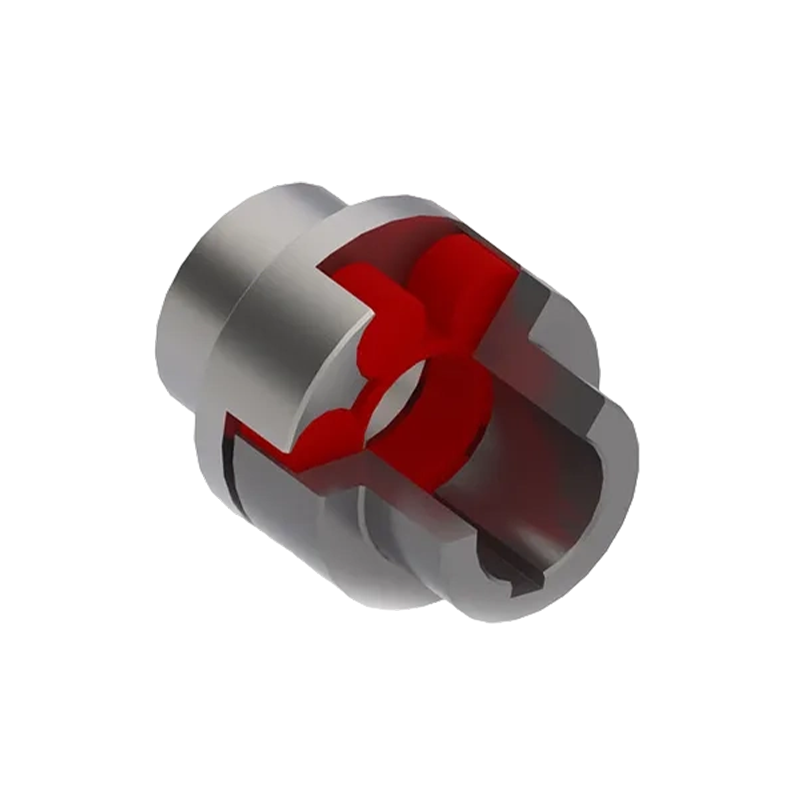 MC Plum-Shaped Elastic Coupling for Industrial DrivesThis flexible jaw-and-spider coupling offers shock absorption and wear resistance, with multiple bore options and a wide torque range for standard machinery.View Product →
Key Advantages of Elastomeric Jaw Couplings
Elastomeric jaw couplings earn their place in countless machines because they are simple, economical, and dependable. They are forgiving in service and do not demand the attention that some other flexible couplings require. The most important benefits include:
- No lubrication is needed, which reduces maintenance time and eliminates the risk of oil leaking onto the surrounding area.
- The elastomeric spider is easy to inspect and quick to replace, often without disturbing the hubs.
- Their compact axial length and light weight allow installation in tight spaces.
- They provide good damping of torsional vibration and shock loads, protecting the connected equipment.
- They are tolerant of small parallel and angular misalignment, which simplifies routine alignment work.
- Compared with metallic flexible couplings, they are a low-cost solution for many general-purpose drives.
How to Select the Right Elastomeric Jaw Coupling
Selecting the right elastomeric jaw coupling is mostly a matter of matching torque, speed, shaft size, and the operating environment. Start by determining the rated torque of the motor or engine, then apply a service factor based on the driven machine and its duty cycle. Machines with heavy shock loads, such as crushers, piston pumps, or conveyor drives, need a larger coupling or a softer spider than machines with smooth, steady loads.
The bore size must match both shafts, and the coupling should be able to transmit rated torque at the expected speed. For high-speed applications above a few thousand rpm, the coupling should be balanced, and the spider should be suitable for the continuous operating temperature. Chemical exposure is another important factor; oil, solvents, and humidity can weaken many elastomers, so the material choice should always consider the environment.
For a broader framework to narrow down your options, you can read our detailed guide on how to select the appropriate coupling. And for applications that require a compact, easily replaceable elastomer element, our star-type elastic coupling offers a similar performance profile with a star-shaped insert and progressive contact surfaces. It is a practical choice for pumps, fans, small conveyors, and light industrial machinery.
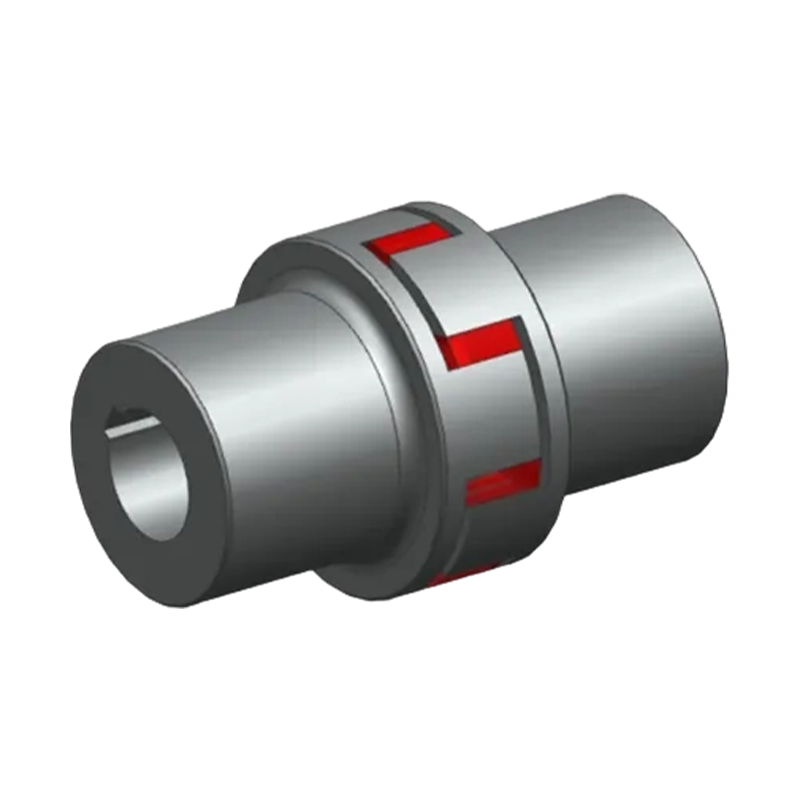 XC Star Elastic Coupling with Maintenance-Free DesignA compact, high-efficiency coupling with a star-shaped elastomer insert, ideal for pumps and conveyors, featuring low inertia and long service life.View Product →
Installation and Maintenance Tips
Good installation starts with a simple alignment check. Although an elastomeric jaw coupling can accept small offsets, better initial alignment results in noticeably longer spider life and lower forces on bearings and seals. Slide the hubs onto the shafts, place the spider in the driving hub, and then bring the driven hub into engagement. When a spider needs replacement, it is not necessary to dismantle the whole drive; simply move the axially located hub back, remove the old element, and press a new one into place.
To keep the coupling in good condition, add these checks to your regular maintenance schedule:
- Inspect the spider for cracks, wear, or compression set at planned intervals, depending on the severity of the duty.
- Look at the jaw faces for hammering marks or deformation, as these indicate shock overload or repeated reverse torque.
- Verify that shaft keys are seated properly and that the hubs are positively locked in place to avoid fretting or unintended axial movement.
Our Experience with Elastomeric Style Couplings
Zhongye Heavy Industry Technology has supplied flexible couplings to the metallurgical, mining, lifting, port, paper, and water industries since 2014. Alongside our standard catalogue, we regularly design non-standard couplings for unusual shaft arrangements, high temperatures, and special operating conditions. Our workshops include a heavy machinery bay and a precision machining bay, and we control quality through every step of manufacture, from raw material inspection to final dimensional verification.
If you are evaluating an elastomeric jaw coupling for a specific drive system, or if you need a custom-sized spider coupling with special bore or mounting features, our engineers are happy to discuss the requirements with you. You are also welcome to learn more about our factory and quality control experience.
Elastomeric jaw couplings remain one of the most practical solutions for connecting rotating machinery in general industry. Their balance of torque damping, misalignment tolerance, and low maintenance is hard to beat. By paying attention to material selection, alignment, and the actual operating conditions, you can achieve years of reliable service. And if the standard catalogue does not cover your needs, remember that non-standard elastomeric jaw coupling designs are very much within our scope.

- Quick Links
- About
- Products
- Our Service
- News & Events
- Contact
- Products Series
- Flexible Couplings with Non-Elastic Elements
- Flexible Couplings with Metal Elastic Elements
- Flexible Couplings with Non-Metallic Elastic Elements
- Safety Coupling
- Rigid Coupling
- Contact Us
- Tel : +86 511 8572 3800 +86 511 8572 3900
- Mobile : +86 15106109009
- Email : sales@couplingzy.com
- Add:No.1 Zhongye Yingbin Avenue, Gaozi Street, Dantu Economic Development Zone, Zhenjiang City, Jiangsu Province, China.


