:+86 15106109009
:sales@couplingzy.com


 English
 русский
 Español
 عربى
 Português
 Deutsch
 Türk
 Indonesia


Why Do Diaphragm Couplings Suddenly Break? A Stress and Fatigue Life Analysis of the Root Causes
Why Do Diaphragm Couplings Suddenly Break? A Stress and Fatigue Life Analysis of the Root Causes
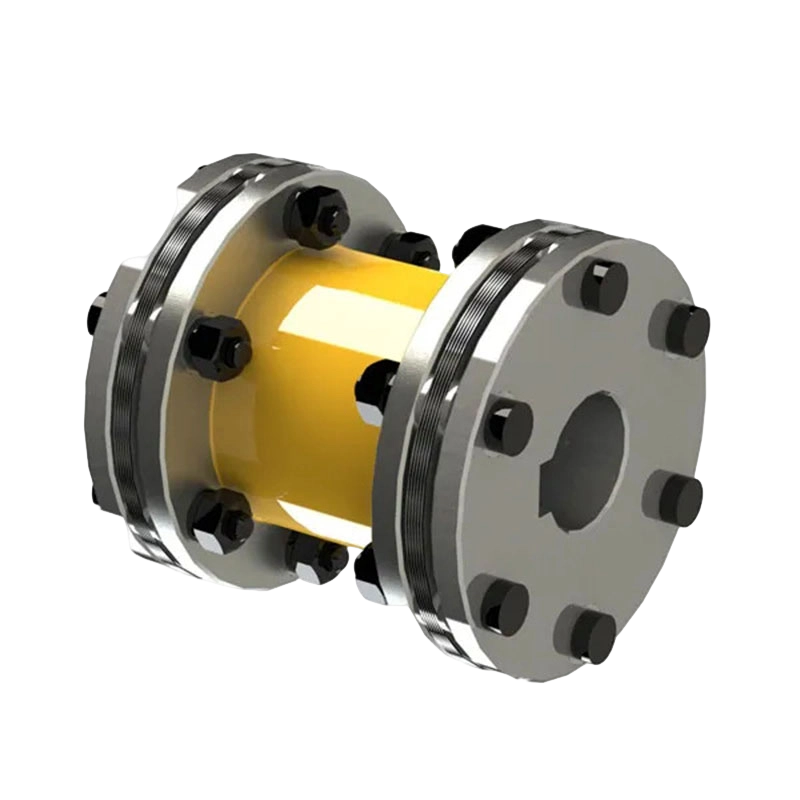
Many customers run into the same problem: a diaphragm coupling that has worked normally suddenly breaks. In most cases this has a lot to do with stress and fatigue life. The following explains the root causes of diaphragm fracture from the perspective of stress analysis.
1. Sources of Stress in a Diaphragm Coupling
The diaphragm is the core elastic element of a diaphragm coupling and is subjected to several kinds of stress in operation. First, torque stress: when torque is transmitted, the diaphragm develops bending stress, and the higher the torque, the greater the bending stress. This is the main working stress on the diaphragm. Second, centrifugal stress: when the diaphragm rotates at high speed, its own mass generates centrifugal force that places tensile stress on the diaphragm, and the higher the speed, the greater the centrifugal stress. This is why the permissible speed of a diaphragm coupling is limited. Third, misalignment stress: when installation alignment is poor, radial, axial and angular misalignment all cause additional bending stress in the diaphragm, and the greater the misalignment, the greater the additional stress. Fourth, thermal stress: when the ambient temperature changes, the diaphragm expands and contracts, producing thermal stress. These four stresses add together to form the total stress the diaphragm actually carries. If the total stress exceeds the fatigue strength of the material, fatigue cracks form under cyclic loading and the diaphragm eventually fractures.
2. Three Fracture Modes of Diaphragms
Depending on the source of stress, diaphragm fracture falls into three main modes. Torque fatigue fracture occurs when torque is too high and the diaphragm runs under overload for a long time. The bending stress exceeds the fatigue strength, fatigue cracks form, and the diaphragm finally breaks. This type of fracture generally occurs at the narrowest part of the diaphragm, with the crack starting at the surface and spreading inward. Centrifugal fatigue fracture occurs when the speed is too high and the centrifugal stress is too large, so the diaphragm works under high centrifugal stress for a long time. This type generally occurs at the outer edge of the diaphragm, because the centrifugal force is greatest there. Misalignment fatigue fracture occurs when alignment is poor and the misalignment is too large, so the diaphragm carries extra bending stress for a long time. This type generally occurs near the bolt holes, because the bolt holes are points of stress concentration.
3. Fatigue Life Calculation
The fatigue life of a diaphragm can be estimated with an S-N curve, which describes the relationship between stress amplitude and the number of fatigue cycles. For a stainless steel diaphragm, when the stress amplitude is below the fatigue limit, the diaphragm can in theory work with infinite life. When the stress amplitude is above the fatigue limit, fatigue life drops sharply as the stress amplitude increases. The fatigue life formula is: N = (σe / σa)^m × N0, where N is the number of fatigue cycles, σe is the fatigue limit, σa is the stress amplitude, m is the fatigue exponent, and N0 is the reference number of cycles. Put simply, the lower the stress, the longer the life; the higher the stress, the shorter the life. So when selecting a coupling, always leave enough margin, and never let the diaphragm work under high stress for long periods.
4. Ways to Extend Diaphragm Life
Based on the stress analysis, the main ways to extend diaphragm life are as follows:
1. Sufficient torque margin: The rated torque should be at least 1.5 times the working torque, which reduces torque stress.
2. Speed within limits: Select strictly according to the permissible speed to reduce centrifugal stress.
3. High alignment accuracy: Align precisely during installation to reduce misalignment stress, and keep radial misalignment within 50% of the permissible value.
4. Good diaphragm material: Choose 304 or 316 stainless steel diaphragms, which have high fatigue strength and long life.
5. Avoid shock loads: For applications with shock loads, select one size larger to reduce the stress amplitude.
With accurate selection, proper alignment and speed kept within limits, the fatigue life of a diaphragm can reach several hundred thousand hours or more, which means ten years or even several decades without replacement.
Zhongye Heavy Industry Technology (Zhenjiang) Co., Ltd. integrates R&D, manufacturing and sales. Its coupling range includes diaphragm, toothed, elastic pin and universal couplings, among others, widely used in metallurgical, mining, water, lifting, paper and port equipment, and the company also undertakes non-standard coupling design and manufacturing. For selection advice, please send us your operating parameters.
- Quick Links
- About
- Products
- Our Service
- News & Events
- Contact
- Products Series
- Flexible Couplings with Non-Elastic Elements
- Flexible Couplings with Metal Elastic Elements
- Flexible Couplings with Non-Metallic Elastic Elements
- Safety Coupling
- Rigid Coupling
- Contact Us
- Tel : +86 511 8572 3800 +86 511 8572 3900
- Mobile : +86 15106109009
- Email : sales@couplingzy.com
- Add:No.1 Zhongye Yingbin Avenue, Gaozi Street, Dantu Economic Development Zone, Zhenjiang City, Jiangsu Province, China.


