:+86 15106109009
:sales@couplingzy.com


 English
  русский
  Español
  عربى
عربى  Português
  Deutsch
  Türk
Türk  Indonesia

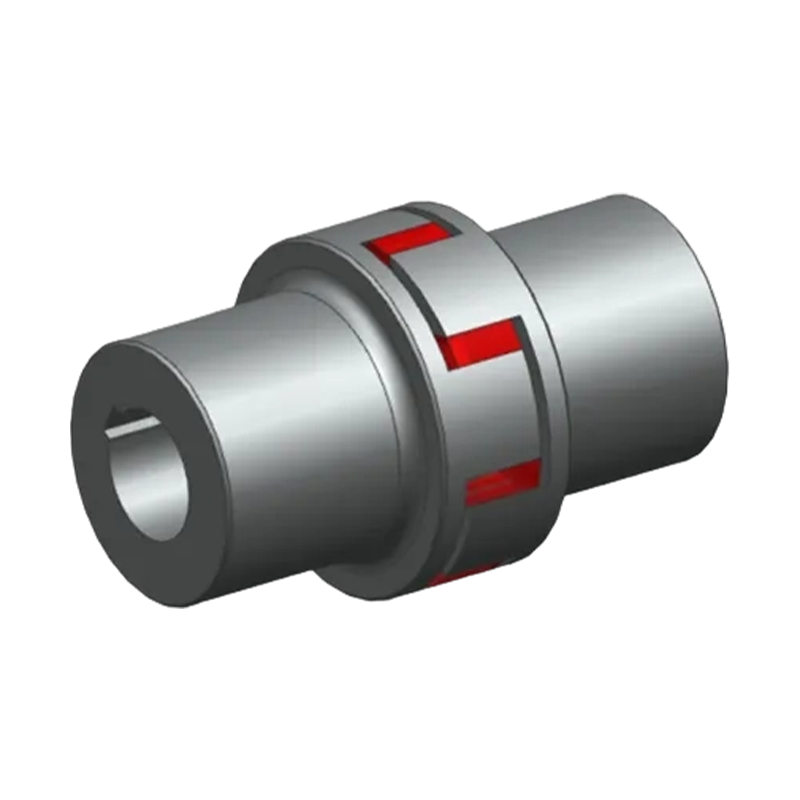
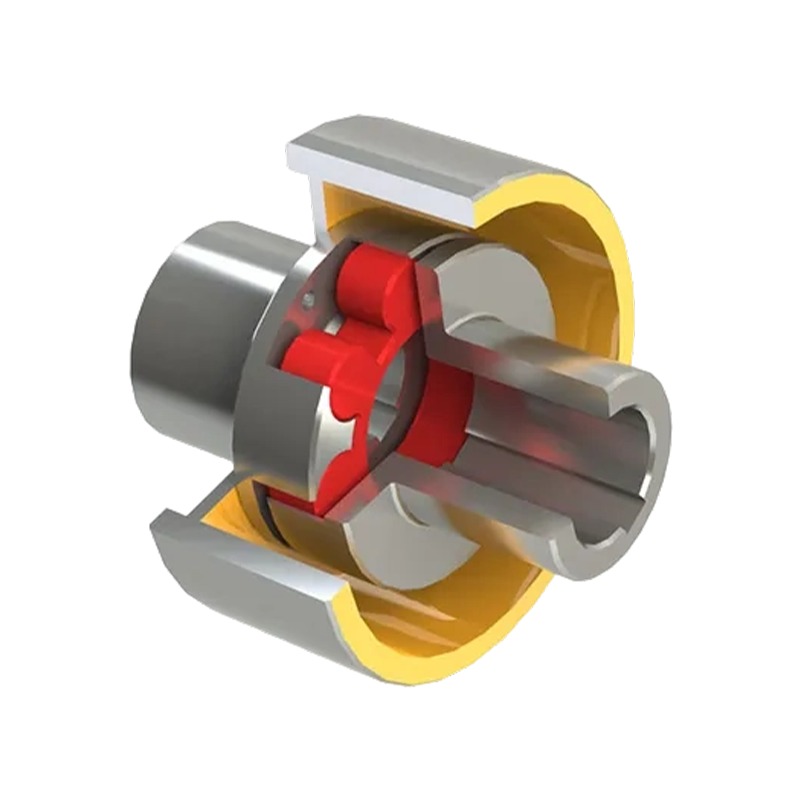
What is the structure and working principle of a non-elastic flexible coupling?
Content
- 1 Classification of Couplings and the Role of Non-Elastic Flexible Types
- 2 Core Structural Components
- 3 Structure and Working Principle of Each Coupling Type
- 4 Misalignment Compensation: An In-Depth Analysis
- 5 Performance Parameter Comparison
- 6 Coupling Selection Principles
- 7 Installation Guidelines and Failure Analysis
- 8 Maintenance and Inspection Schedule
In mechanical power transmission systems, couplings serve as the essential link between a driving shaft and a driven shaft, transferring torque while accommodating the physical realities of installation and operation. Non-elastic flexible couplings represent an important category within this family — they permit a degree of relative displacement between connected shafts without relying on elastic elements to absorb vibration. Valued for their compact construction, strong load-carrying capacity, and high transmission stiffness, these couplings are widely applied in metallurgy, mining, marine engineering, chemical processing, and heavy industrial machinery.
Classification of Couplings and the Role of Non-Elastic Flexible Types
Couplings are broadly divided into two categories based on whether they permit relative shaft displacement:
- Rigid couplings require precise alignment of both shafts and allow no relative displacement in any direction. They transmit torque directly and are used only where shaft alignment can be guaranteed and maintained.
- Flexible couplings accommodate a defined degree of axial, radial, or angular misalignment between connected shafts, making them suitable for a much wider range of installation conditions.
Flexible couplings are further subdivided into two types:
- Elastic flexible couplings incorporate resilient elements such as rubber or polyurethane inserts. These elements absorb vibration and buffer shock loads, but the flexibility of the elastic material limits transmission stiffness and load capacity.
- Non-elastic flexible couplings contain no elastic elements. Misalignment compensation is achieved through relative motion between rigid mechanical components — sliding, rotating, or meshing contacts. This construction delivers high transmission stiffness and strong load capacity, though it provides no inherent vibration damping.
The principal types of non-elastic flexible couplings include gear couplings, Oldham (cross-slider) couplings, universal joint (Cardan) couplings, and chain couplings, each offering a distinct structural form and range of suitable applications.
Core Structural Components
Despite their structural differences, all non-elastic flexible couplings share a common set of functional components.
Driving and Driven Half-Couplings
Each coupling assembly consists of two half-couplings, one mounted on the driving shaft and one on the driven shaft. They are fixed to their respective shafts by keys, splines, or interference fits to ensure synchronous rotation. Half-couplings are the primary torque-transmitting elements and are typically manufactured from cast iron, cast steel, or forged steel, selected according to the magnitude of the load and the operating environment.
Intermediate Transmission Element
The intermediate element is the component that enables misalignment compensation. Its form varies by coupling type: gear couplings use external gear hubs meshing with internal gear sleeves; Oldham couplings use a central disc with two sets of mutually perpendicular driving keys; universal joint couplings use a cross-shaped trunnion; chain couplings use a double-strand roller chain. The design of the intermediate element directly determines the coupling's displacement compensation capacity and load-bearing performance.
Sealing and Lubrication System
For coupling types that require lubrication — most notably gear couplings — an effective sealing system is indispensable. Seals retain lubricating grease within the coupling housing and prevent external contaminants from entering the contact zones. The integrity of the sealing system has a direct bearing on service life. Common seal configurations include O-ring seals, lip seals with garter springs, and labyrinth seals.
Fastening and Locating Elements
Bolts, retaining rings, and end plates fix the axial position of each component and prevent axial migration during operation. These elements ensure that the coupling remains correctly assembled under the dynamic loads encountered in service.
Structure and Working Principle of Each Coupling Type
Gear Coupling
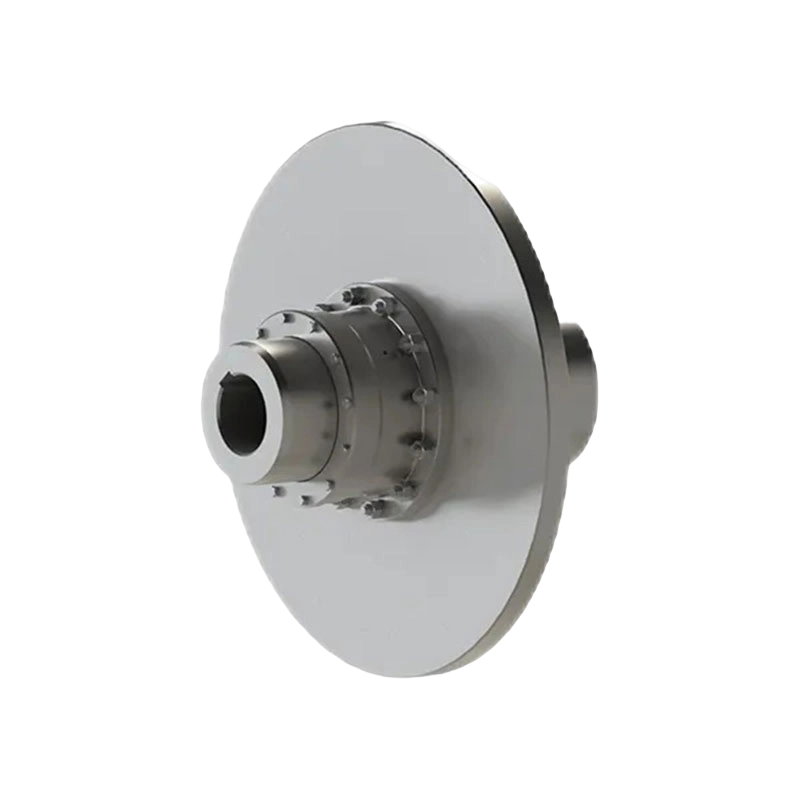
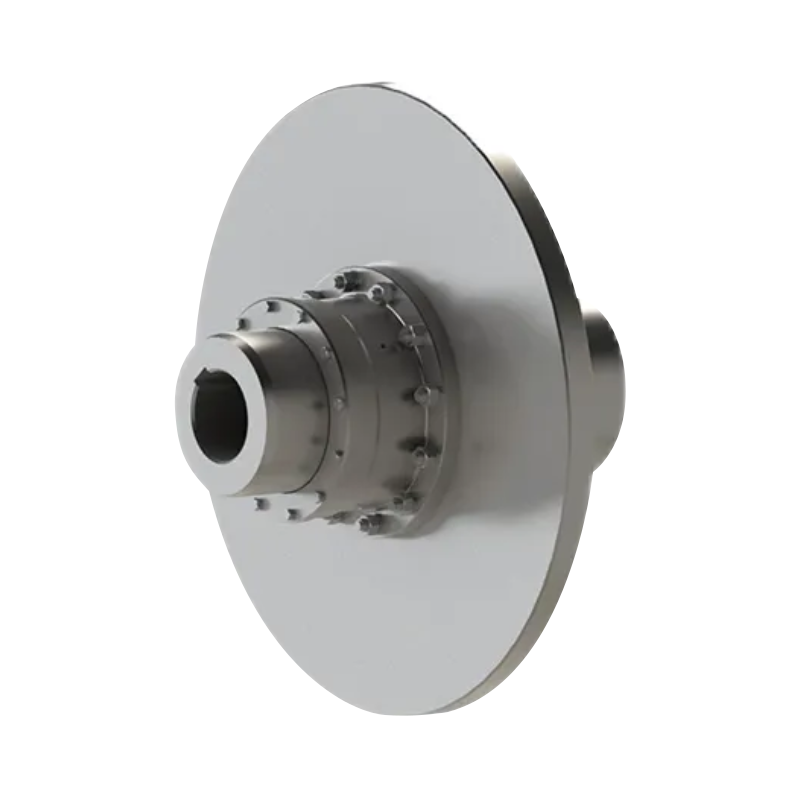
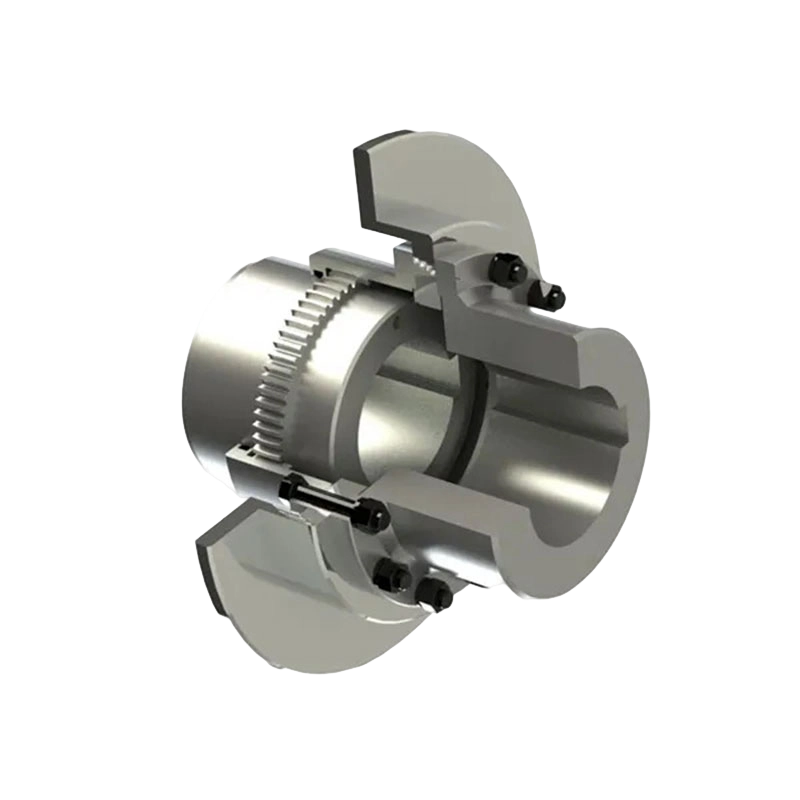
The gear coupling is the most widely used non-elastic flexible coupling for high-torque, high-speed applications. Its structure comprises two external-toothed hubs — one on each shaft — and two internal-toothed sleeves bolted together to form a sealed lubricant chamber enclosing both gear meshes.
Torque is transmitted through the meshing contact between the external gear teeth on the hubs and the internal gear teeth in the sleeves. When angular misalignment exists between the two shafts, the crowned (barrel-shaped) tooth profile of the external gear allows the hub to rock within the sleeve, accommodating the angular offset. Radial misalignment is compensated by a small lateral displacement of each hub within its sleeve. The crowning radius of the external teeth determines the maximum permissible angular displacement — a larger crown radius permits greater angular offset.
Gear couplings typically accommodate angular misalignment of 0.5° to 1.5°. Transmission efficiency is high, often exceeding 99%, making them the preferred choice for rolling mill drives, mine hoists, and heavy-duty machine tool spindle transmissions.
Oldham Coupling (Cross-Slider Coupling)
The Oldham coupling consists of two half-couplings, each with a diametral slot on its face, and a central intermediate disc carrying two pairs of driving keys orientated at 90° to each other. The keys engage the slots in the half-couplings to form sliding connections.
Torque is transferred through the contact surfaces between the keys and slots. When the two shafts are radially offset, the central disc slides independently within each half-coupling's slot, and the relative sliding of the keys within the slots absorbs the radial displacement. The intermediate disc acts as a kinematic cross-guide mechanism, permitting the two shafts to translate relative to each other in any radial direction without interrupting torque transmission.
Oldham couplings are simple in construction and economical to manufacture. They are suitable for low-speed applications (generally not exceeding 250 r/min) with relatively large radial offsets — typically up to approximately 0.04 times the shaft diameter. At higher speeds, centrifugal forces generated by the eccentric mass of the sliding disc produce additional dynamic loads on the shaft, making this type unsuitable for high-speed drives.
Universal Joint Coupling (Cardan Coupling)
The cross-type universal joint consists of two fork-shaped flanges (yokes) and a cross-shaped trunnion. The four journals of the cross are each connected to a bearing hole in one of the two yokes through needle roller bearings, forming two mutually perpendicular hinge joints.
Torque passes from the driving shaft to the driving yoke, through the cross trunnion to the driven yoke, and on to the driven shaft. Because the connections between the cross and both yokes are hinged, the coupling can transmit torque with a shaft intersection angle of up to 35°–45°, accommodating angular deviations far beyond the capability of gear or Oldham couplings.
An important kinematic characteristic must be noted: when a single universal joint operates with a non-zero shaft angle, the driven shaft does not rotate uniformly even when the driving shaft turns at constant speed. The angular velocity of the driven shaft fluctuates twice per revolution, with the amplitude of fluctuation increasing with the shaft angle. To eliminate this velocity non-uniformity, a double universal joint arrangement is used in practice — two joints connected by an intermediate shaft of equal length, with equal angles at both ends and the two yokes of the intermediate shaft positioned in the same plane. This geometry causes the velocity fluctuations at each joint to cancel, delivering uniform output speed. Universal joint couplings are widely employed in automotive driveshafts, rolling mill roller tables, and construction machinery.
Chain Coupling
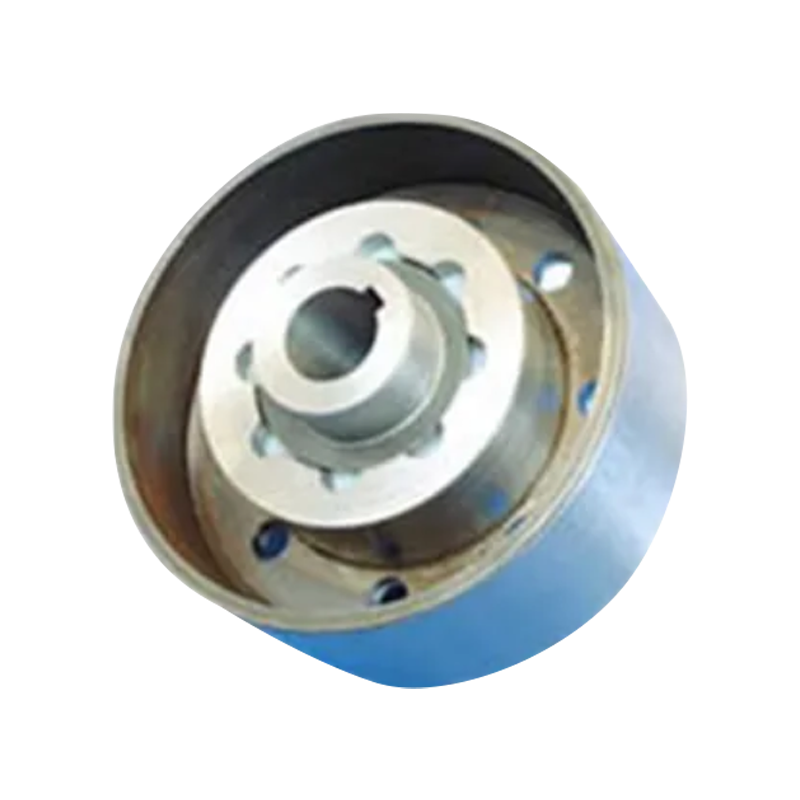
The chain coupling consists of two identical sprockets — one mounted on each shaft — connected by a double-strand roller chain, enclosed within a protective cover to prevent chain disengagement and contamination ingress.
Torque is transmitted from the driving shaft through the meshing contact between the sprocket teeth and the chain rollers, along the chain to the driven sprocket and shaft. The clearance between the chain and sprocket teeth, combined with the slight geometric flexibility of the chain links, allows the coupling to compensate for axial, radial, and angular misalignment simultaneously. Typical allowances are approximately one chain pitch in the axial direction, about 0.02 times the chain pitch radially, and around 1° angularly.
Chain couplings are straightforward to assemble and disassemble — separating the master link allows the two shafts to be fully decoupled without disturbing other drive components. This makes them particularly suited to applications with frequent reversal, frequent starting cycles, or maintenance-intensive environments, and they are commonly found in conveyor systems, agricultural machinery, and textile equipment.
Misalignment Compensation: An In-Depth Analysis
The ability to compensate for relative shaft displacement is the defining characteristic that distinguishes flexible couplings from their rigid counterparts. Three categories of shaft misalignment are recognized in engineering practice:
- Axial displacement (δx): Relative movement of the two shaft ends along their common axis, typically caused by thermal expansion of shafts or housings during operation, or by installation tolerances.
- Radial displacement (δy): A condition in which the two shaft axes are parallel but not coincident — a lateral offset perpendicular to the shaft axis. This arises from installation errors, foundation settlement, or deflection under load.
- Angular displacement (α): A condition in which the two shaft axes intersect at an angle. Causes include installation error, bearing wear, and deformation of the machine frame under load.
Non-elastic flexible couplings accommodate these deviations through relative motion between the intermediate element and the half-couplings. However, this compensation is not unlimited — every coupling type has a defined maximum displacement allowance. Operating beyond these limits causes a rapid increase in supplementary loads on the shafts and bearings, accelerating wear and potentially leading to premature failure. Accurate alignment during installation is therefore essential, even for flexible couplings.
Unlike elastic couplings, which absorb misalignment through deformation of a compliant element, non-elastic flexible couplings generate sliding or rotating contact between rigid components when compensating displacement. These contact forces manifest as supplementary bending moments and axial forces acting on the connected shafts and bearings and must be included in the mechanical analysis during the coupling selection process.
Performance Parameter Comparison
The table below provides a comparative overview of the key performance parameters of the four principal non-elastic flexible coupling types.
| Type | Radial Compensation | Angular Compensation | Axial Compensation | Speed Range | Load Capacity | Typical Applications |
|---|---|---|---|---|---|---|
| Gear Coupling | Small | 0.5°–1.5° | Small | High (up to 3,000+ r/min) | High | Rolling mills, mine hoists, heavy machine tools |
| Oldham Coupling | Large (≈0.04d) | Very small (≈0.5°) | Small | Low (≤250 r/min) | Medium | Low-speed heavy drives, pumps, compressors |
| Universal Joint | Medium | Large (up to 35°–45°) | Medium | Medium | Medium–High | Automotive driveshafts, rolling mill tables, construction equipment |
| Chain Coupling | Small (≈0.02t) | ≈1° | ≈1 chain pitch | Low–Medium (≤600 r/min) | Medium | Conveyors, agricultural machinery, textile equipment |
Coupling Selection Principles
Correct coupling selection is a prerequisite for reliable operation and extended service life. The following criteria should be evaluated systematically during the selection process:
- Determine the design torque. Multiply the nominal operating torque by a service factor that accounts for the type of prime mover (electric motor, internal combustion engine) and the load characteristics of the driven machine (smooth, moderate shock, heavy shock). Service factors typically range from 1.2 to 3.0.
- Assess misalignment type and magnitude. Identify whether the dominant misalignment is radial, angular, or axial, and estimate its magnitude based on installation conditions. Select a coupling type whose compensation capacity matches or exceeds the expected misalignment.
- Consider the operating speed. Gear couplings are the preferred choice for high-speed drives. Oldham couplings suit low-speed applications with large radial offsets. Universal joints handle large angular deviations. Chain couplings are appropriate for medium-to-low-speed applications requiring frequent reversals or starts.
- Evaluate the operating environment. High temperatures, corrosive media, dust, and moisture impose additional requirements on materials and sealing. High-temperature applications require heat-resistant lubricating greases; corrosive environments may call for stainless steel components or protective coatings.
- Consider maintenance accessibility. Chain couplings offer the simplest disassembly procedure and suit maintenance-intensive installations. Gear couplings require periodic grease replenishment on a defined service schedule.
Installation Guidelines and Failure Analysis
Key Installation Guidelines
Installation quality has a direct and lasting impact on coupling performance and service life. The following practices should be observed:
- Thoroughly clean shaft ends, keyways, and bore surfaces before assembly. Remove all burrs, corrosion, and contamination to ensure proper fit quality.
- Use a dial indicator to measure radial and face runout during alignment. Confirm that actual misalignment values fall within the coupling's rated compensation limits — visual inspection or straightedge checks alone are insufficient.
- After installing a gear coupling, fill it with the specified grade and quantity of lubricating grease to ensure adequate lubrication of all tooth contact surfaces from initial startup.
- Fit the protective cover with careful attention to sealing integrity. Inadequate sealing allows grease to escape and permits abrasive particles to enter the meshing zone.
- Tighten all fastening bolts incrementally in a cross pattern to the specified torque, preventing distortion caused by uneven clamping.
Common Failure Modes
Understanding the failure modes characteristic of each coupling type supports effective condition monitoring and timely maintenance:
- Tooth surface wear (gear couplings): Caused by inadequate lubrication, lubricant degradation, or sustained operation beyond the rated misalignment limits. Progressive wear leads to increased backlash, vibration, and ultimately tooth pitting or fracture.
- Slider wear (Oldham couplings): Accelerated by high-speed operation, overloading, or poor lubrication of the key-and-slot contact surfaces. Wear produces clearance, which introduces impact loading and further accelerates deterioration.
- Chain fatigue fracture (chain couplings): Cyclic tensile and bending stresses in the chain links cause fatigue crack initiation and propagation. Uneven load distribution across the chain width from angular misalignment accelerates this process.
- Cross trunnion bearing failure (universal joints): Insufficient lubrication, overloading, or operation beyond the rated shaft angle leads to needle bearing wear and seizure, eventually resulting in trunnion fracture.
- Half-coupling cracking or fracture: Excessive impact loads, material defects, or severe misalignment generating supplementary bending moments that exceed the material's allowable stress can initiate fatigue cracks in the hub body.
Maintenance and Inspection Schedule
A systematic maintenance program is essential for preserving the performance and extending the service life of non-elastic flexible couplings. The following measures should be incorporated into the equipment maintenance plan:
- Scheduled lubricant replenishment: Gear and chain couplings should have their lubricating grease topped up or replaced according to the manufacturer's service intervals — typically every 2,000 to 4,000 operating hours for replenishment, with a full grease change at least once per year.
- Alignment verification at major overhauls: Re-check coupling alignment whenever bearings are replaced, foundations are repaired, or significant vibration has been observed. Foundation settlement and thermal cycling can alter the alignment state over time.
- Wear assessment of active elements: Periodically inspect gear teeth, slider keys, chain links, and trunnion bearings for wear. Replace components that have reached their wear limits before failure occurs to avoid secondary damage to shafts, bearings, and connected equipment.
- Seal condition inspection: Examine lip seals, O-rings, and cover gaskets for signs of ageing, deformation, or damage. Address any leakage by replacing the affected sealing elements promptly.
- Continuous operational monitoring: During normal operation, monitor for abnormal vibration, unusual noise, or elevated temperature at the coupling location. Any of these indicators warrants an immediate investigation before further damage develops.
- Quick Links
- About
- Products
- Our Service
- News & Events
- Contact
- Products Series
- Flexible Couplings with Non-Elastic Elements
- Flexible Couplings with Metal Elastic Elements
- Flexible Couplings with Non-Metallic Elastic Elements
- Safety Coupling
- Rigid Coupling
- Contact Us
- Tel : +86 511 8572 3800 +86 511 8572 3900
- Mobile : +86 15106109009
- Email : sales@couplingzy.com
- Add:No.1 Zhongye Yingbin Avenue, Gaozi Street, Dantu Economic Development Zone, Zhenjiang City, Jiangsu Province, China.


